Trust Atoms is an educational resource focused on making science and complex subjects easier to understand through clear, accessible, and informative content.

Read More

Our content is designed for curious readers, students, and lifelong learners who want to explore scientific ideas and educational topics in a more approachable way.

We cover subjects across astronomy, biology, chemistry, physics, human anatomy, earth science, and additional educational categories as the site continues to expand.

Our goal is to simplify complex concepts through structured explanations, foundational guides, and educational articles designed to help readers build knowledge and better understand how the natural world works.

Start with our broad overview in What Is Science?, which introduces the major scientific disciplines and how they connect.

All content on this site is intended for educational and informational purposes with an emphasis on clarity, accessibility, and continued learning.

Start exploring with our foundational guides:

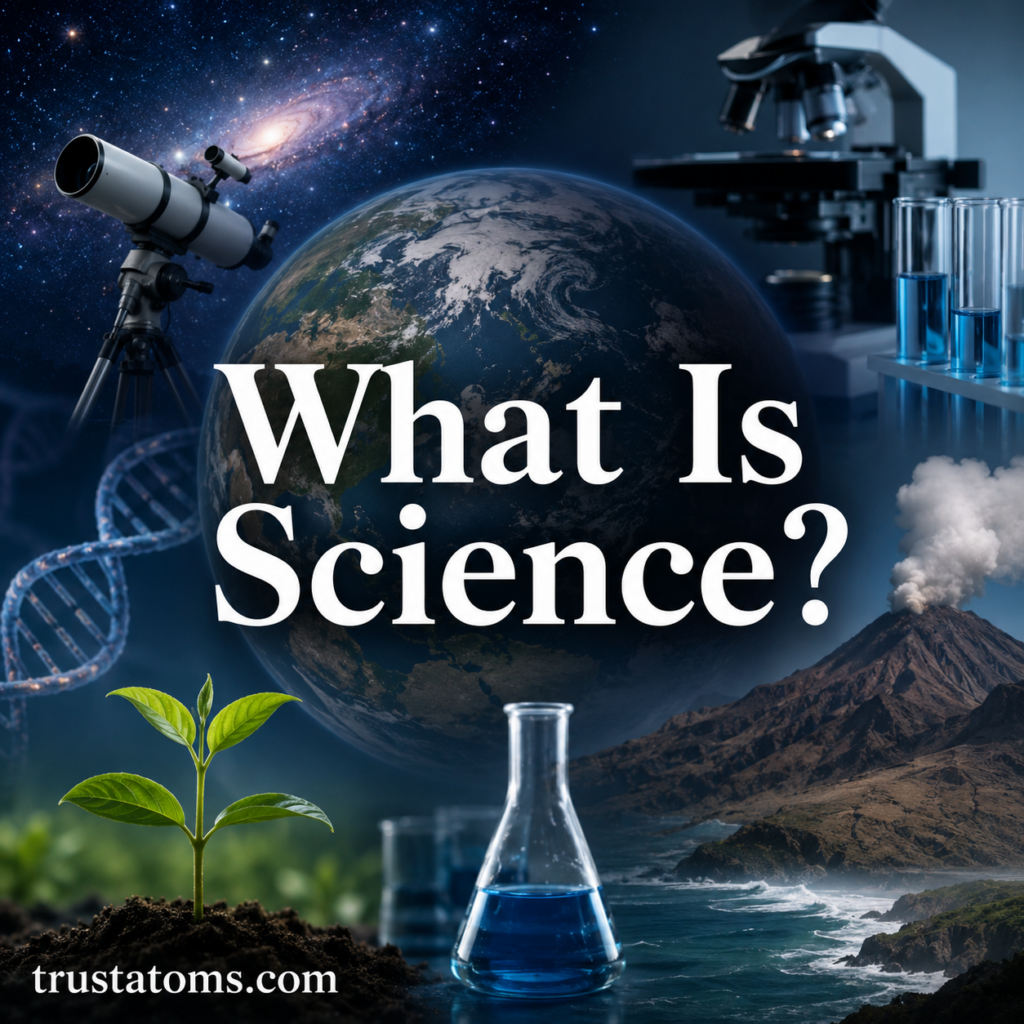
What Is Science? Understanding the Study of the Natural World

What Is Science illustration showing major scientific disciplines including astronomy, biology, chemistry, Earth science, and physics.
Illustration representing the major branches of science and how scientific disciplines work together to explain the natural world. trustatoms.com.

Science is the systematic study of the natural world through observation, experimentation, evidence, and analysis. It seeks to understand how the universe works by exploring patterns, testing ideas, and developing explanations based on measurable evidence.

From microscopic cells to distant galaxies, science helps explain the structure of matter, the behavior of living organisms, the forces of nature, and the processes that shape our planet and universe.

Science is not limited to laboratories or textbooks. It influences medicine, technology, transportation, communication, environmental research, and countless aspects of everyday life.

Trust Atoms explores science through multiple disciplines including Astronomy, Biology, Chemistry, Earth Science, Human Anatomy, and Physics.

Continue reading “What Is Science? Understanding the Study of the Natural World”
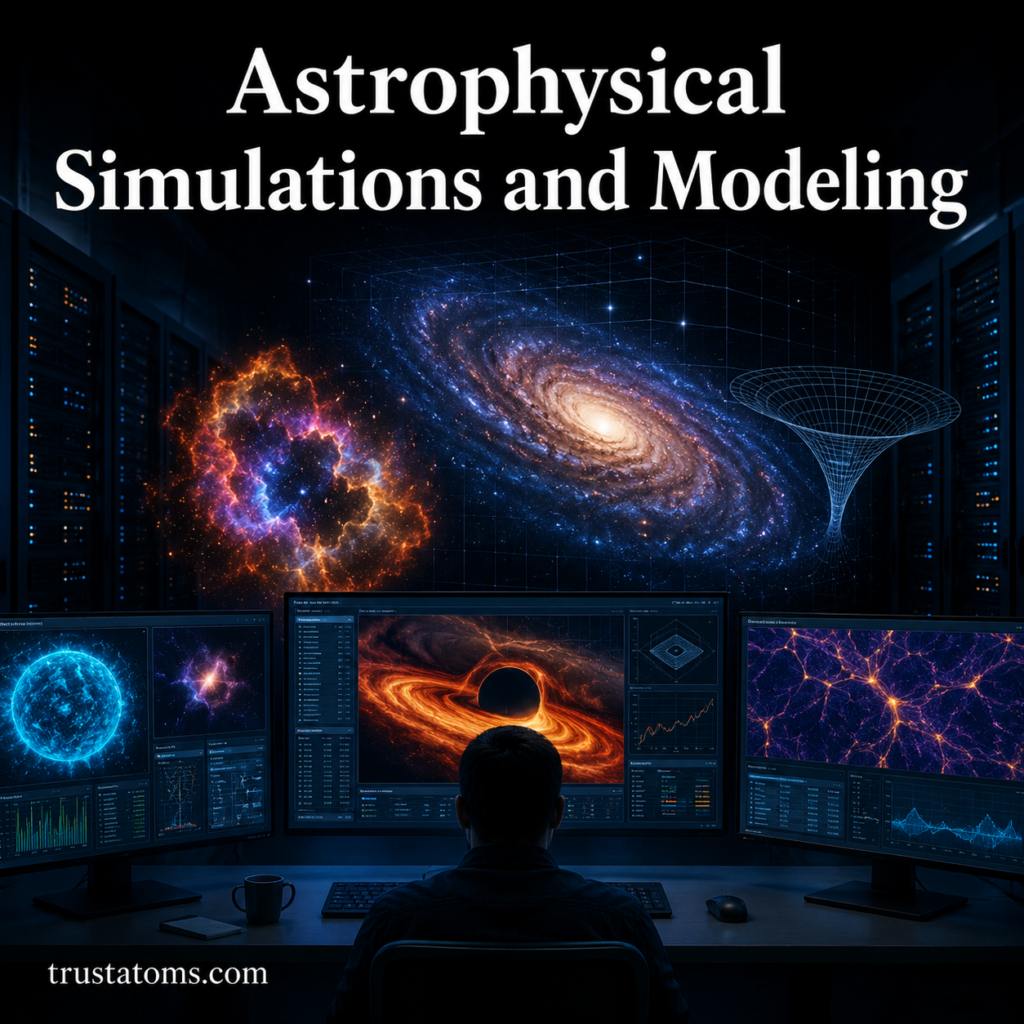
Astrophysical Simulations and Modeling

Illustration showing astrophysical simulations on computer monitors featuring galaxies, black holes, cosmic structures, and space modeling data.
Visualization of astrophysical simulations and computational modeling used to study galaxies, black holes, and cosmic evolution. trustatoms.com.

Modern astronomy studies objects and events occurring across enormous distances, extreme temperatures, and timescales far beyond direct human experience. Because scientists cannot physically manipulate stars, galaxies, or black holes in laboratories, researchers often rely on astrophysical simulations and computational modeling to better understand how the universe works.

Astrophysical simulations use mathematics, physics, and advanced computing to recreate cosmic processes digitally. These models help scientists test theories, predict behavior, and interpret astronomical observations.

From galaxy formation and black hole collisions to planetary climates and supernova explosions, simulations have become essential tools in modern astrophysics.

This guide explores how astrophysical simulations work, what scientists model, and why computational astronomy plays such an important role in understanding the universe.

Continue reading “Astrophysical Simulations and Modeling”

Cosmic Dust and Interstellar Particles

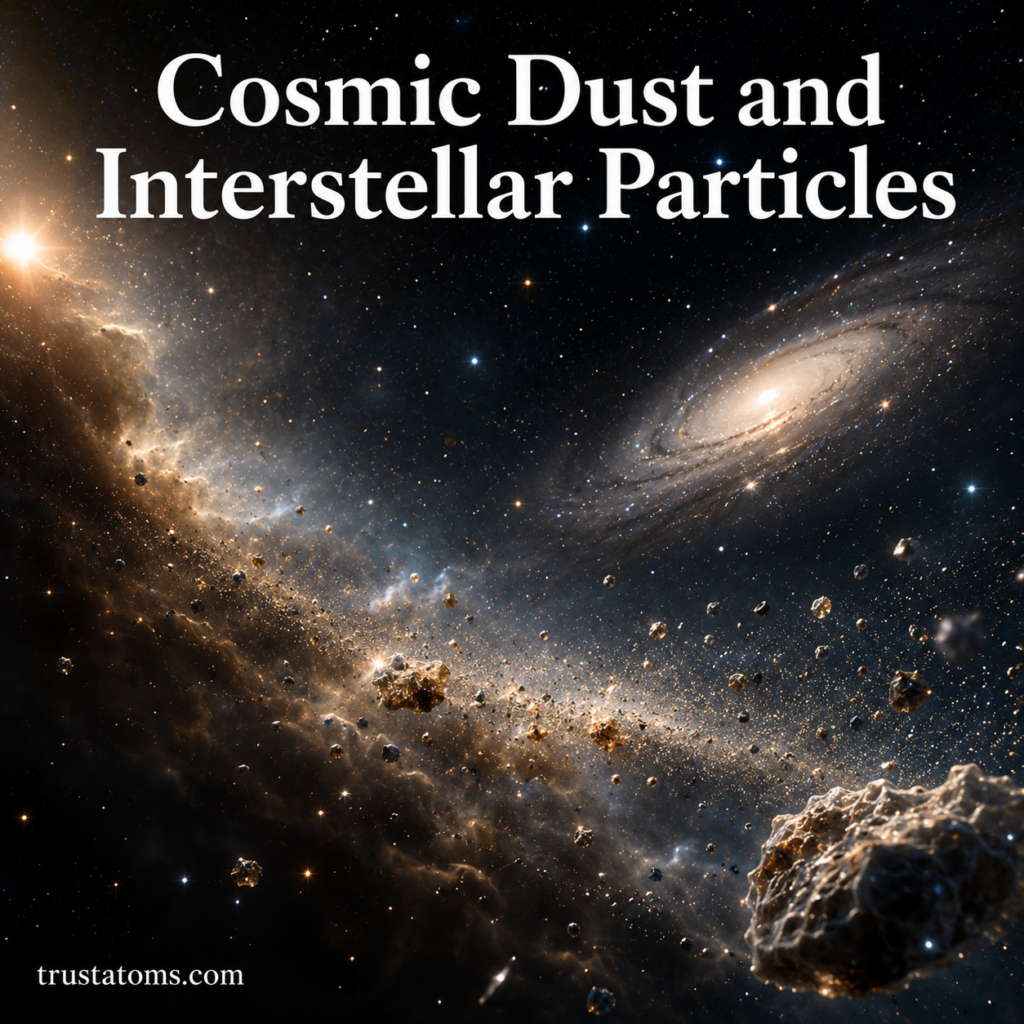
Illustration showing cosmic dust, interstellar particles, nebulae, and scattered debris drifting through deep space near a spiral galaxy.
Visualization of cosmic dust and interstellar particles moving through nebulae and galactic regions in deep space. trustatoms.com.

Space is often imagined as completely empty, but the universe is actually filled with tiny particles drifting between stars and galaxies. These microscopic materials, known as cosmic dust and interstellar particles, play major roles in the formation of stars, planets, moons, and even complex molecules.

Although individual dust grains are extremely small, vast clouds of interstellar material can stretch across enormous distances and shape the appearance and evolution of galaxies.

Modern astronomy has revealed that cosmic dust is not simply debris floating in space — it is an important ingredient in many astrophysical processes that help build planetary systems and influence how light travels across the universe.

This guide explores what cosmic dust is, where interstellar particles come from, how scientists study them, and why they matter in astronomy.

Continue reading “Cosmic Dust and Interstellar Particles”

Habitability Beyond Earth

Illustration showing potentially habitable planets beyond Earth with a space observatory overlooking an alien planetary landscape.
Conceptual illustration of habitability beyond Earth featuring exoplanets, distant stars, and astronomical observation technology. trustatoms.com.

For centuries, humans have wondered whether life could exist beyond Earth. Modern astronomy has transformed that question from speculation into an active scientific field focused on planetary habitability.

Habitability refers to the potential of an environment to support life under suitable conditions. While Earth remains the only known world confirmed to host life, scientists continue discovering planets, moons, and environments that may possess some of the ingredients considered important for biological activity.

Advances in telescopes, planetary science, astrobiology, and atmospheric analysis have dramatically expanded the search for potentially habitable worlds throughout the universe.

This guide explores how scientists evaluate habitability beyond Earth, what conditions may support life, and which locations in space are considered promising candidates for future research.

Continue reading “Habitability Beyond Earth”

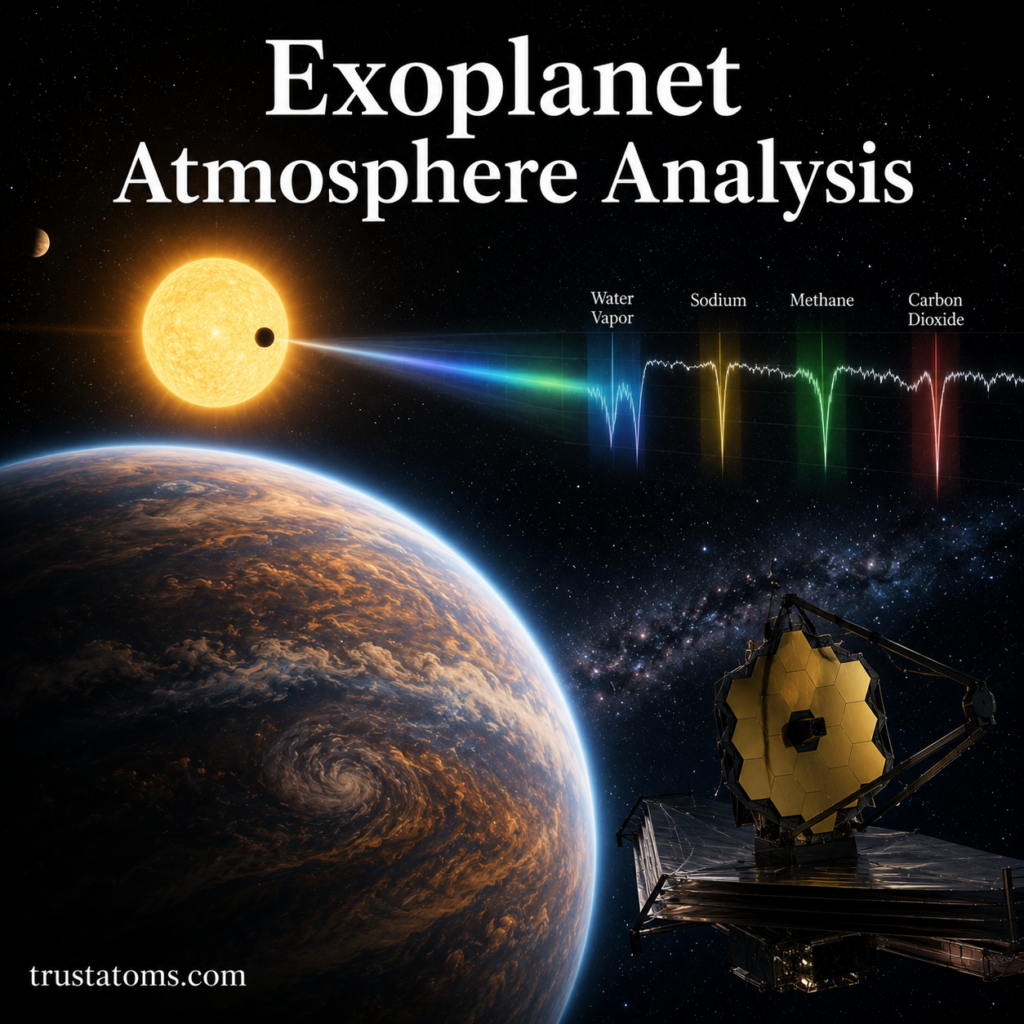
Exoplanet Atmosphere Analysis

Illustration showing an exoplanet atmosphere being analyzed through spectroscopy with a space telescope and light spectrum data.
Visualization of exoplanet atmosphere analysis using spectroscopy, starlight filtering, and space telescope observations. trustatoms.com.

Thousands of exoplanets — planets orbiting stars outside our solar system — have been discovered over the past few decades. While finding these distant worlds is impressive on its own, one of the most exciting areas of modern astronomy involves studying their atmospheres.

Exoplanet atmosphere analysis allows scientists to investigate the gases, temperatures, weather systems, and chemical compositions surrounding distant planets. These studies help researchers better understand how planets form, how they evolve, and whether some worlds may potentially support conditions suitable for life.

Using advanced telescopes and spectroscopy techniques, astronomers can analyze tiny changes in light from stars and planets to uncover information about atmospheres located light-years away from Earth.

This guide explores how exoplanet atmospheres are studied, what scientists look for, and why atmospheric analysis has become one of the most important fields in astronomy.

Continue reading “Exoplanet Atmosphere Analysis”

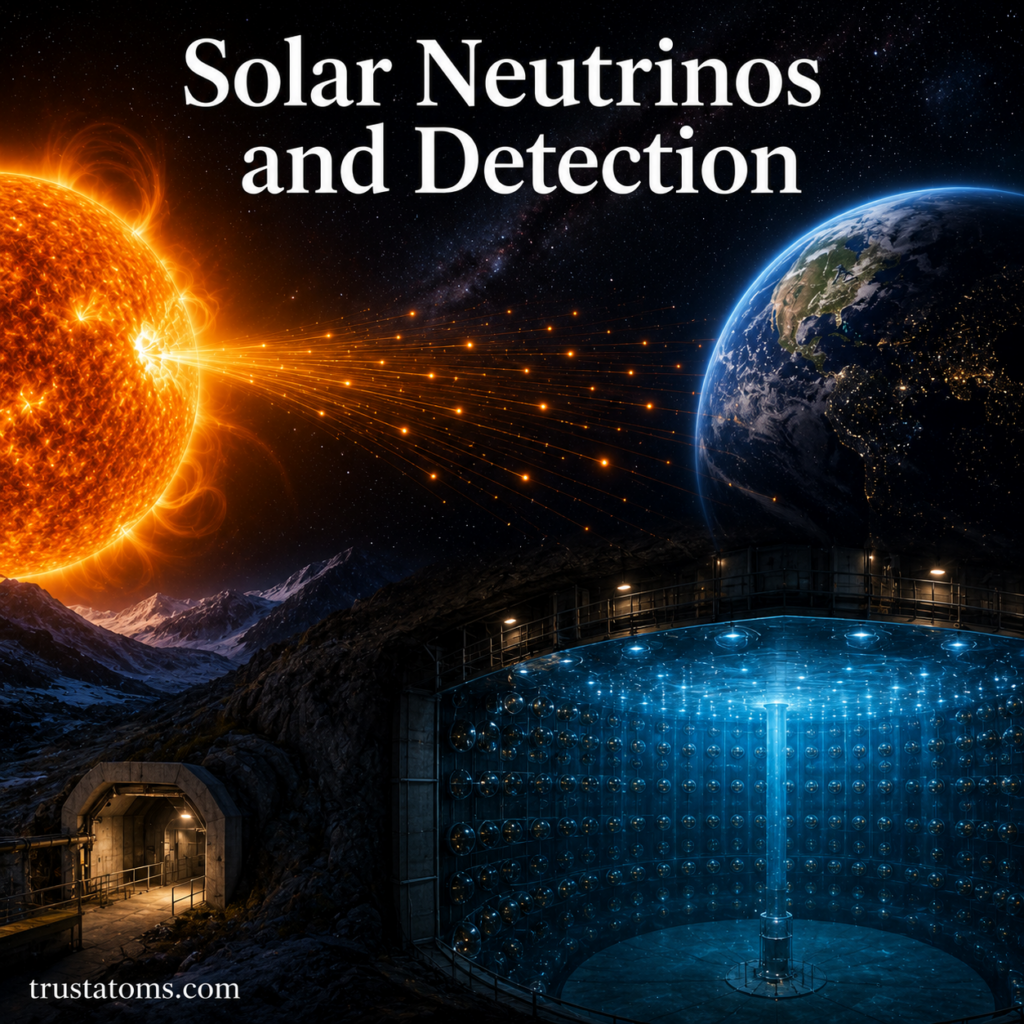
Solar Neutrinos and Detection

Illustration showing solar neutrinos traveling from the Sun toward Earth and an underground neutrino detection laboratory.
Conceptual illustration of solar neutrinos traveling through space and being studied inside a deep underground neutrino observatory. trustatoms.com.

The Sun constantly produces enormous amounts of energy through processes occurring deep within its interior. Alongside light and heat, these processes also create tiny subatomic particles called neutrinos.

Solar neutrinos are incredibly difficult to detect because they interact only weakly with matter. Trillions of them pass through your body every second without leaving any trace. Despite their elusive nature, studying solar neutrinos has become one of the most important areas in modern astrophysics and particle physics.

By detecting neutrinos from the Sun, scientists can directly observe activity occurring deep inside the solar interior — regions that ordinary light cannot immediately escape from.

This guide explores what solar neutrinos are, how they form, why they matter, and how researchers detect these ghost-like particles.

Continue reading “Solar Neutrinos and Detection”

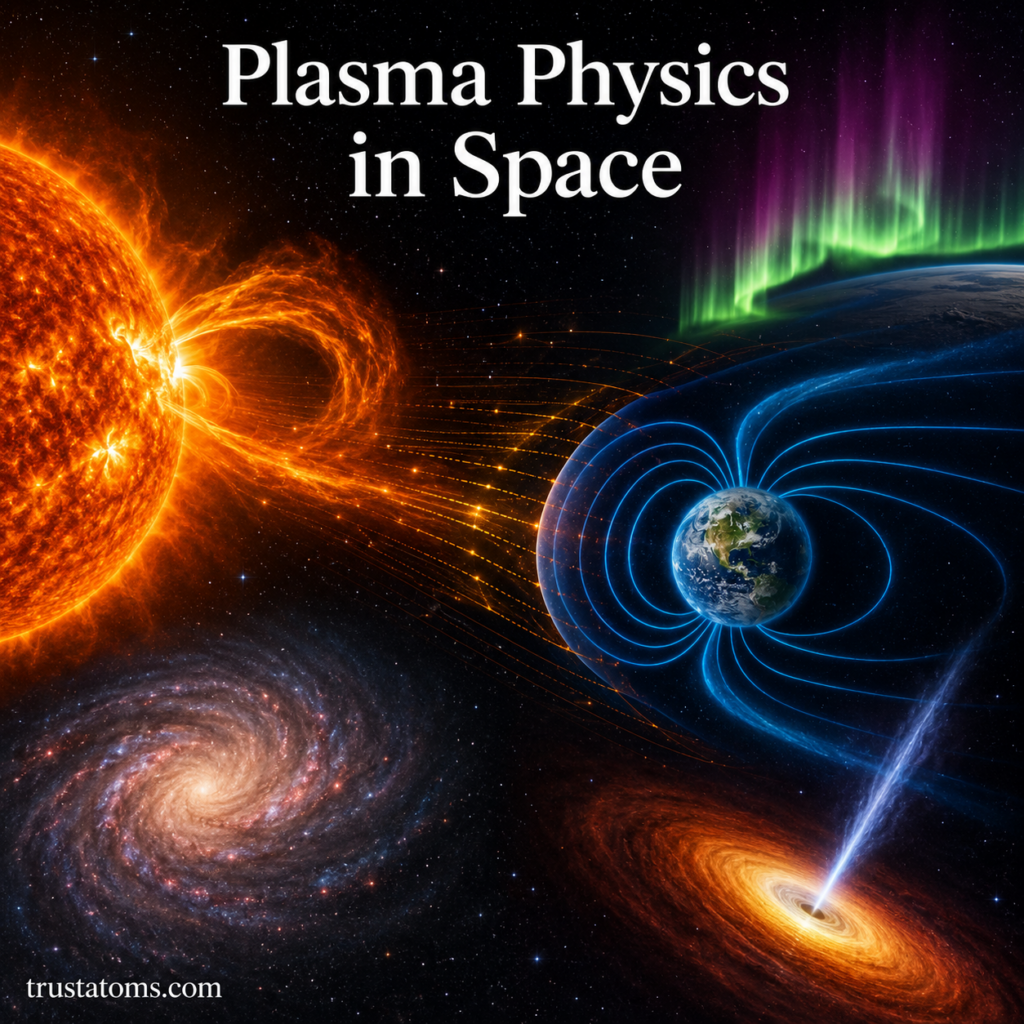
Plasma Physics in Space

Illustration of plasma physics in space showing the Sun emitting solar plasma toward Earth’s magnetosphere with auroras, galaxies, and a black hole jet in the background.
Visualization of plasma physics in space featuring solar activity, Earth’s magnetic field, auroras, and energetic cosmic phenomena. trustatoms.com.

Space may appear empty at first glance, but much of the universe is actually filled with plasma — an energized state of matter made of charged particles. From the Sun’s outer atmosphere to interstellar clouds and distant galaxies, plasma dominates the visible universe and drives many of the most powerful cosmic phenomena.

Understanding plasma physics helps scientists explain solar flares, auroras, cosmic radiation, planetary magnetospheres, and even the behavior of stars and black holes. It also plays an important role in protecting Earth’s technology from space weather disruptions.

This guide explores how plasma behaves in space, where it is found, and why it is essential to modern astronomy and astrophysics.

Continue reading “Plasma Physics in Space”

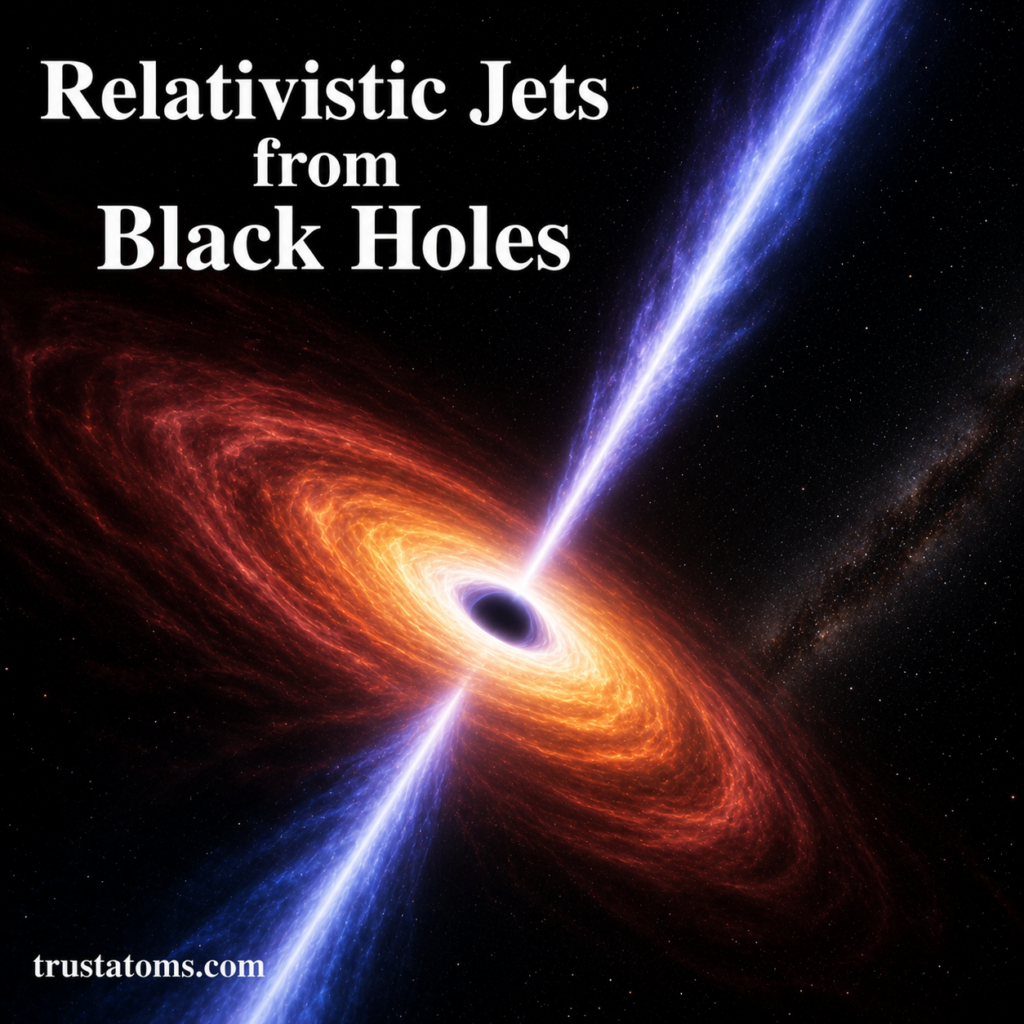
Relativistic Jets from Black Holes

Illustration of relativistic jets blasting outward from a spinning black hole and glowing accretion disk.
A conceptual illustration showing powerful relativistic jets emerging from the magnetic environment surrounding a black hole. trustatoms.com.

Relativistic jets are among the most energetic and visually spectacular phenomena in the universe. These enormous beams of high-speed particles can extend for thousands or even millions of light-years from black holes, releasing immense amounts of energy into surrounding space.

Despite black holes being famous for trapping matter and light, they are also capable of powering some of the brightest and most violent cosmic structures ever observed.

Scientists study relativistic jets to better understand black holes, magnetic fields, plasma physics, galaxy evolution, and the extreme environments surrounding compact objects.

Continue reading “Relativistic Jets from Black Holes”

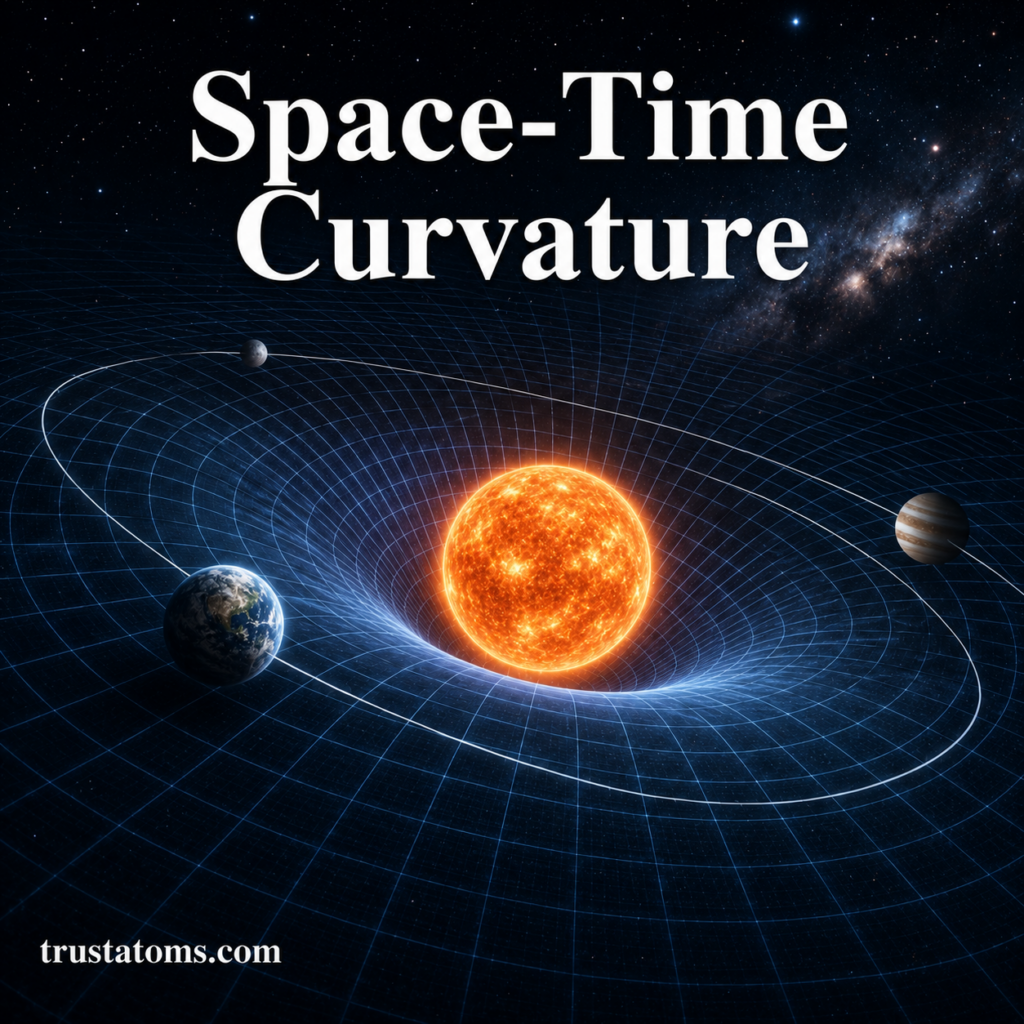
Space-Time Curvature

Illustration of a star bending the fabric of space-time with planets orbiting within a curved gravitational field.
A conceptual illustration showing how massive objects curve space-time and influence planetary motion through gravity. trustatoms.com.

Space-time curvature is one of the most important concepts in modern physics. Introduced through Albert Einstein’s theory of general relativity, it changed humanity’s understanding of gravity, motion, and the structure of the universe itself.

Instead of viewing gravity as an invisible force pulling objects together, Einstein proposed something radically different: massive objects bend the fabric of space and time, and that curvature guides how matter and light move.

This idea explains everything from planetary orbits to black holes, gravitational lensing, and even the expansion of the universe.

Continue reading “Space-Time Curvature”

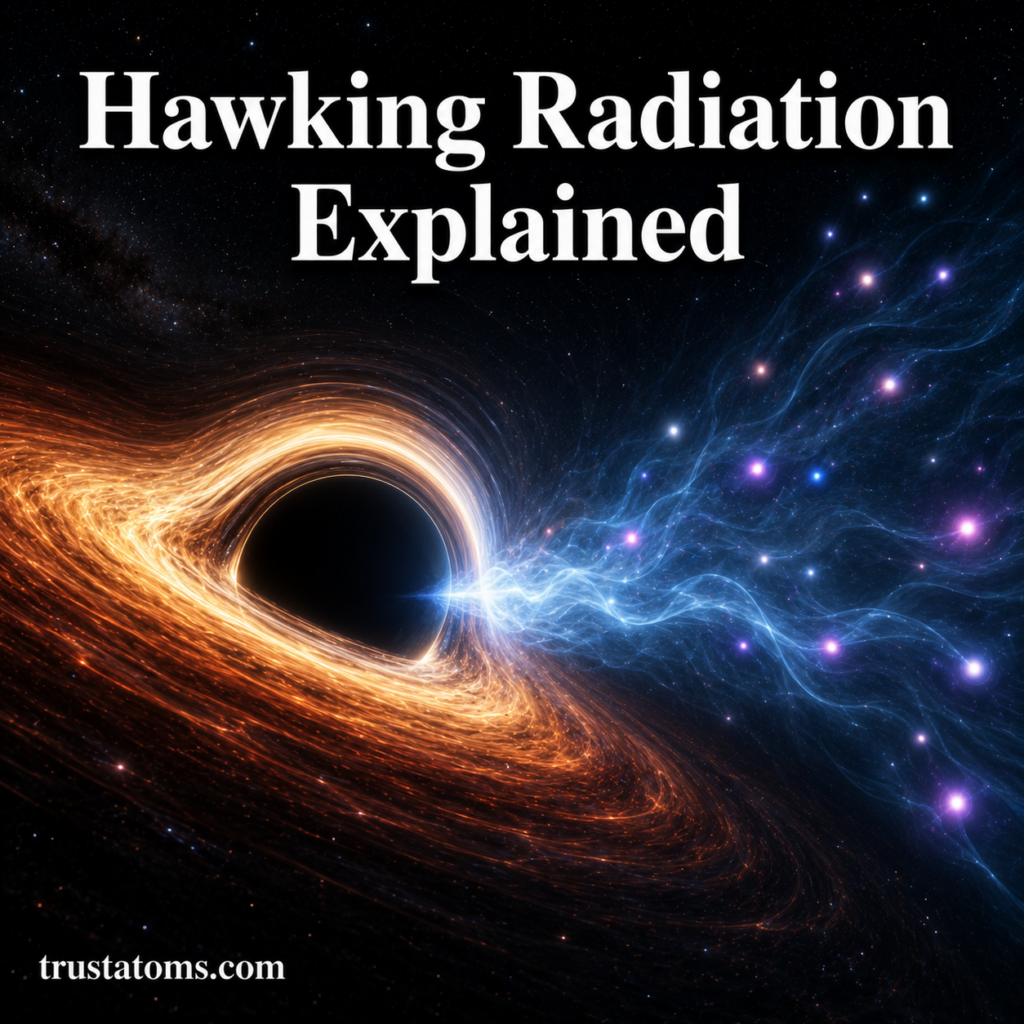
Hawking Radiation Explained

Illustration of a black hole emitting Hawking radiation particles into deep space.
A conceptual illustration showing Hawking radiation escaping from the edge of a black hole’s event horizon. trustatoms.com.

Hawking radiation is one of the most fascinating and surprising ideas in modern physics. Proposed by physicist Stephen Hawking in 1974, the theory suggests that black holes are not completely black after all.

Instead of trapping everything forever, black holes may slowly emit tiny amounts of radiation and eventually evaporate over enormous periods of time.

This groundbreaking idea connected two major areas of physics:

  • General relativity
  • Quantum mechanics

Because these theories normally describe very different scales of nature, Hawking radiation became one of the most important concepts in theoretical astrophysics.

Continue reading “Hawking Radiation Explained”